The Phoenix Police Department held a press conference this afternoon to discuss the findings of the soon-to-be-released report on the investigation into the death of Sergeant Sean Drenth, who was found shot to death near the State Capitol last October.
The report, as Phoenix police officials explain, offers a lot of questions, but few answers as to who shot Drenth -- and it's still unclear whether his death was a suicide or murder.
One thing, however, seems clear: Drenth wasn't the only person at the scene in the 29-minute window from when he got there to when his body was discovered by a State Capitol Police officer.
Detectives were able to track Drenth's movements for the two hours prior to when his body was discovered via-a GPS device in his squad car. According to Lieutenant Joe Knott, head of the P.P.D.'s homicide unit, Drenth was doing routine patrol in the areas between 7th Avenue to the I-17, and Buckeye Road and Jefferson Street during the two hours before his death.
About 10:26 p.m., Drenth's vehicle pulled into a parking lot near railroad tracks across from the state capitol. The spot is popular amongst cops who often park there to do paperwork. Drenth activated a computer device in his cruiser that indicates when he's stopped someone, which suggests he'd encountered someone near the parking lot.
About 30 minutes later, his body was discovered next to the open passenger door of his squad car with a shotgun wound under his chin and his shotgun resting on his chest as he lay on his back.
"The biggest question is the position of the shotgun," Knott says. He notes, it's very possible someone staged the crime scene and placed the shotgun on Drenth's dead body, so finding the gun on his chest isn't the smoking gun (pardon the pun) that he killed himself.
Adding to the mystery is that Drenth's service weapon was found on the other side of a fence on the west side of the parking lot where his body was found. Another of Drenth's weapons was found next to his body. One bullet had been fired in the direction of where the other gun was found.
If Drenth killed himself, it seems he made the scene as confusing as possible for investigators -- unless someone found his body in the 29 minutes between when he got to the parking lot and when his body was discovered and moved evidence around; a scenario police aren't ruling out.
"We have significant evidence to suggest someone was at the scene," Knott says. Finding out who that person was is the problem investigators continue to face.
Based on police interviews with friends and family, it doesn't seem as though Drenth was the kind of guy who wanted to kill himself.
"Absolutely nobody thinks Sean Drenth would have killed himself for any reason," Knott says of those close to the dead sergeant.
In his own opinion of whether Drenth was murdered or committed suicide, Knott doesn't know what to think.
"I started at 50/50 [in terms of whether it was murder or suicide]," he says. "Throughout the investigation, that's shifted in both directions...it's extremely frustrating."
Knott says we may never know exactly what happened to Drenth, but the case remains open and the department will continue to investigate.
The recent very suspicious death of Phoenix police Sgt. Sean Drenth (as yet unsolved) and October's outrageous murder of unarmed Phoenix resident Daniel Rodriguez in his own home by Officer Richard Chrisman provides me an opportunity to revisit some of the points I made in an article I wrote a few years ago called "Officer Down: The Media and Cop-Killings". In that piece, I pointed out how when an officer is killed in the line of duty, in general no investigation into the officer's record or character is permitted, because to do so would put into question the religious nature of this society's attitudes (and especially those of the media institutions) towards the police.
Dead cops are treated like little dead angels -- heroes, pure of heart and motive, who meet their tragic end too soon and in defense of the smallest among us. It's as if every cop dies rescuing an old lady from a house on fire, a box of kittens under one arm and a guilty-faced arsonist firmly gripped by the collar in the other. Justice served!
A common attack lobbed at those who dare criticize the cops and their role in society is that, despite one's lack of faith in the oft-touted immaculateness of the paladin in blue, "They'd protect you, too, even though you hate them." Of course, those of us who have seen their brutality liberally meted out in person know better. For instance, one reason most Americans have never been clubbed by a cop is because they've never been to a protest, not because cops don't beat people at protests. Likewise, middle class white people generalize their at worst mildly annoying experiences with ticket-issuing cops to everyone else, and therefore remain baffled each and every time a black kid is dragged from a car and beaten by one of them.
The coverage given to cops, and the heaps of posthumous praise piled on them, is rivaled but not surpassed, only by the attention given to dead soldiers. Perceived disparagers of the troops or their mission are counseled that they fight for our right to dissent, even if not the rights of those they invade and torture (although their defenders rarely even concede that much). And as with cops, only the most superficial investigations into their mission is countenanced. They do violence in far off villages so that we can be free, the logic goes. Not to protect and advance the interests of the capitalist and political class. No, nothing so crass, to be sure. In the common parlance, all enemies of the military are Hitler or terrorists with ticking time bombs. Of the cop, their targets are child molesters, murderers and rapists. And all critics of the police and ("our") soldiers are appeasers, ingrates or apologists for the above listed menagerie of the foes of honest humanity. Or Reds. Now we start to get to the crux of it, don't we?
When a cop dies, freeways are shut down, like the 101 in the north Valley was for Drenth's corpse and it's accompanying tearful and politically opportunistic entourage. Traffic is diverted, local politicians and police officials are given free reign to praise the officer in the media without suffering the cruel editor's snips and cuts. Sometimes the media covers the funeral procession live. Flags are lowered to half-staff. Again, just like soldiers. Indeed, the willingness of capitalist society to shut down its holy arteries of commerce to venerate its fallen protectors reveals their true purpose. But we already knew that.
Which again brings me to the case of Sgt. Drenth, Officer Chrisman and a host of other officers in the South Mountain Precinct of the Phoenix Police Department. I can't think of another time when the sheer force of scandal has compelled onto the public discourse the question of police sainthood. Or at least it should. In a way we have to count ourselves lucky at the odd convergence of circumstances that now provides us the opportunity to interrogate again the question of police and the way they are held up in society.
Called on a domestic disturbance between Daniel Rodriguez and his mother, which was over by the time he arrived, Officer Chrisman barged into Rodriguez's mobile home, put his service weapon to Rodriguez's head, shot his dog and then, eventually, opened fire on Rodriguez himself as he attempted to leave the trailer with his bike. "I don't need a warrant," he is reported to have said in response to Rodriguez's protestations. The act so outraged his partner, Sergio Virgillo, who was present when it happened (which says a lot, as we'll see later) that he broke the blue code of silence and denounced Chrisman to investigators.
Still, the police union ran to his support, paying his $150,000 bail with union dues. Phoenix Law Enforcement Association (PLEA) President Mark Spencer, a notorious anti-immigrant activist and right-wing Christian, showed up in the courtroom for Chrisman's initial appearance wearing a "We Support Officer Richard Chrisman" t-shirt. Initially and reluctantly, the state only charged Officer Chrisman with aggravated assault and animal cruelty.
Public outrage and a series of protests, which went on for a week, eventually compelled the outgoing County Attorney Rick Romley to charge Chrisman with second-degree murder. Stating his overall support for the police, and the defense of the bad apple myth of policing, Romley was careful to reassure the cops that his issuing of the new charge wasn't a sign of his straying from the fold. "But we as citizens put our trust and our lives in their hands, and when one violates and abuses that trust, we must hold them accountable to the community for that breach," he told the press.
An interesting side note, last year following the anti-Joe Arpaio march, the Phoenix New Times reacted with a vengeance worthy of a puritanical witchhunt to the Dine', O'odham, Anarchist Bloc's assertion that the Phoenix Police were as bad, if not worse in many ways, than the Sheriff's Department. After all, the PPD is responsible for more deportations than Sheriff Joe, hands down. The immigrant movement here had put a lot of faith in the PPD as the heroes of their anti-Joe campaign and would brook no criticism of their saviors -- even when PPD deliberately and without provocation charged their horses into a mixed age crowd, trampling people and pepper spraying indiscriminately. Interestingly, several of those arrested, including one for throwing a water bottle at heavily armed police during the melee, among other complaints, were charged with the same crime as was Chrisman initially, who is alleged to have murdered an unarmed man.
Indeed, the press, especially the New Times, is directly responsible in no uncertain terms for the charges filed against anarchists following that event and the fact that our comrades continue to face prosecution (with one, Grace, having just been released after serving a month in Joe's jail as a result of the state's blackmail operation). So, it's with some chagrin that I note that, almost a year later, the New Times has come to the startling conclusion that, in fact, the PPD is as rife with abuse and corruption as the MCSO. Better late than never, I suppose, but it would be nice if anarchists got some credit for saying it first and didn't have to suffer alone the consequences of standing up against such nonsense. But I suppose that was a different PPD that attacked the march last January, right?
So, let's get back to Chrisman. A little digging, the result I'm sure of the pure monstrosity of his actions and the fact that he is a living as opposed to dead cop (of whom not a bad word would be permitted), revealed something interesting. Chrisman was on something called the "Brady List". That list, which can be viewed here, is composed of officers who have been singled out for acts of dishonesty while on the job. In Chrisman's case, the black mark came when he was observed by a couple of security guards on camera harassing a homeless woman and planting a crack pipe on her.
What was he doing with a crack pipe, you may wonder? Maybe ask the fine officers of the New Orleans Police Department who, it has been revealed recently, routinely carried with them what they used to refer to as a "ham sandwich" -- i.e., an untraceable pistol to plant in case an officer involved shooting revealed no weapon on the victim. Remarkably in the case of Chrisman we have a case here where security guards, generally power hungry and drooling sycophants to the police that they hope one day themselves to be, were so outraged by his behavior that they turned him in. Quite astounding, really. It makes you wonder what his uncontroversial activity was like, doesn't it?
But that outrage is not a rare exception, it turns out. It has since been revealed that the head of the Phoenix Police Department's internal investigation squad was himself on the Brady List! And do you know what else? Revelations from a three year long investigation into the false billing of overtime by officers in the PPD has revealed a ring of fraud within the department, in which what has been reported to be as many as 25 officers in the South Mountain Precinct, aided by sympathetic bosses, routinely billed for overtime that never happened, padding their already inflated wages. Three officers have been charged with serious felonies as a result, probably just sacrificial lambs to cover up whatever else has been going on.
But something interesting came to light as a result of this investigation that really bears remarking on: according to the reports coming out now, if Sgt. Sean Drenth was still alive, he would have been indicted as well. Which would make the officer over which the city elite so recently poured out it's glycerin tears, the latest fallen hero in a long line of since-beatified saints, just another corrupt cop in a corrupt department.
To make this connection even more clear, Officer Chrisman has been reported to be among those under investigation as well, putting our fallen angel Sgt. Drenth a mere one degree of separation, if not a co-conspirator, with alleged murderer Chrisman in the overtime scam. But, to be fair, one degree is in fact too far, since the accused mastermind of the operation, Officer Contreras (recently retired under "multiple misconduct investigations"), actually played in a band with Drenth. The fact that Contreras comes from a long-time Phoenix police family certainly casts more doubt on the reputation of the department and, of course, any future or past fallen officers from that particular cesspool in South Mountain, mired as it is now in public scandal and accusations of racism. Hero cops indeed!
In this new era of austerity, and despite the overwhelmingly obvious corrupt and violent nature of our co-called "protectors", where we are reminded daily that teachers and other public employees (amongst the last remaining pathways to decent wages in this country) must face the imposed precarity of regular review of their qualifications and suffer the constant threat of dismissal, it's interesting that we have heard no such demands when it comes to the police. As a friend of mine recently remarked to a cop on the light rail, "They'd let children starve before they didn't pay you."
And make no mistake, when those children are starving, and you reach for that loaf of bread to tuck under your now-ill-fitting clothing, it will be one of these officers, not Drenth thankfully, but one of his corrupt, roid-raging and hair-trigger comrades, that intervenes to keep that food from their mouths. These are the saints of our time? Or is it perhaps something else?
I won't go into it in depth again, because I already did that in "Officer Down", but suffice it to say that, if as we've seen above, the cops aren't a bunch of angels protecting us from the thugs and thieves that would otherwise plague good people, then something else must be going on. At the least, as it would be a mark of insanity to defend the mainstream image of the police officer, it also makes no sense to be shocked that jobs that offer largely unaccountable power over others and unsupervised opportunities for theft and bullying in fact attract people interested in acting like a bunch of cowboy jerks that take advantage of people, push them around, plant drugs and steal (just to begin a very long list). In that sense, the image of the police officer is perfect cover for them. But beyond that, of course, we have the particular role of the police as a system in the US. Born out of the slave patrols in the South, the anti-Mexican militias in the Southwest, and the anti-worker thugs that broke up strikes, the legacy of the police remains with us to this day, defending the wealth and power of the elite first, of the settler second and of everyone (or no one) else third, except perhaps by accident or convenience. Let's not parse words or dance around the issue: the thin blue line in fact defends capitalism and the state from it's victims, ensuring that people like us don't get out of line and that the rich and their bureaucratic buddies in the government stay safe, warm and well-fed in their mansions and downtown penthouses. The cops keep the money rolling in! They reinforce white supremacy, protecting some from the worst excesses of capitalist and bureaucratic power in exchange for their acquiescence in the hyper-domination of the rest of society.
The police, far from the angelic agents of our deliverance from evil, are in fact a hallmark and the bulwark of a deeply unequal class society, in which power is exercised against the will and against the interests of the vast majority of the population. Each time one falls should be a time for celebration, not mourning, for it brings us a little bit closer to a world without cops, a world without inequality.
In Spain during the revolution the workers and peasants, so infuriated at the apologists for the monarchy and feudalism, dug up the rotting corpses of the priests and nuns that had conjured the myths of their age -- the lies that sought to keep the farmer and the factory worker in his or her place, bowing always to the appropriate authority figure. Perhaps we can think of counterparts in our own society, who deserve similar tribute, should the time come. So, please, weep no more over the dead cop than the dead slave patroller, or the dead Pinkerton. No rose on the grave, but who's got a shovel?
Forensic efforts to link DNA evidence collected at the scene of Phoenix police Sgt. Sean Drenth's fatal shooting have yielded no results, according to investigators who believe additional analyses could take several more months.
More than 10 weeks ago Drenth was found dead Oct. 18 alongside his patrol vehicle in a line-of-duty tragedy that has baffled detectives who have yet to confirm if Drenth was murder or if he committed suicide.
As the investigation continued earlier this month, Drenth was implicated in an off-duty work scandal reviewed by the Arizona Attorney General's Office. The case led to felony charges against three current Phoenix police officers and a former officer.
Phoenix police leaders said Drenth could have also faced felony charges because the sergeant's alleged misconduct would have met the criteria for grand-jury consideration. He was among the officers accused of receiving money for off-duty security work they didn't perform.
Drenth, a longtime south Phoenix patrolman, was found dead around the time Phoenix learned about the Attorney General's Office investigation.
Officers investigated as part of the Attorney General's Office probe were required to submit DNA samples for the Drenth homicide investigation.
On Tuesday, Phoenix police Sgt. Trent Crump announced that investigators have failed to make a link between DNA samples and evidence collected from the scene of Drenth's death.
"The overall processing of the evidence and comparative analysis is not complete and is expected to take several months," Crump wrote in an e-mail. "We will continue working on the case until all leads have been exhausted."
The Maricopa County Medical Examiner's Office has not yet released Drenth's completed death investigation. Reports take as long as three months, meaning that an official record would likely be released by Jan. 18.
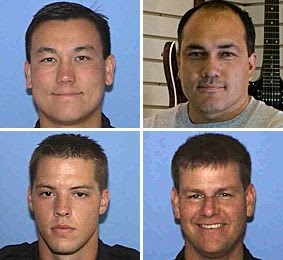
Dirty Phoenix cops: Sgt. Benjamin Sywarungsymun (from top left, clockwise), George Contreras, Officer Steven Peck and Officer Aaron Lentz
Three current and one former member of the Phoenix Police Department indicted on felony theft charges pleaded not guilty Wednesday to taking money for off-duty security work that allegedly was never performed.
The charges against former Officer George Contreras and current Officers Benjamin Swarungsymun, Steven Peck and Aaron Lentz cap a three-year state investigation into the officers' involvement in an off duty security job.
Meanwhile, KTAR Radio reports all four men were ordered by the court to submit DNA samples in the death investigation of Phoenix police Officer Sean Drenth. Contreras' attorney Cary Lackey says there's no connection between the security case and Drenth's death.
Police Chief Jack Harris says Drenth's alleged misconduct involving off-duty work would have been taken to the grand jury for consideration of charges.
PHOENIX - A jury has indicted three current and one former member of the Phoenix Police Department on felony theft charges -- and had Sgt. Sean Drenth still lived -- he would be indicted too.
According to the indictment, officers in the South Mountain Precinct billed businesses for off-duty work they allegedly did not do.
This is a story we've been following for weeks now.
It involves a troubled apartment complex in south Phoenix. One of the alleged businesses, Cotton Center Townhomes, suffered the largest hit -- involving a security job contracted with the Phoenix Police Department by three homeowners associations to help reduce crime in the area.
The officers allegedly billed the business for off-duty security work that was never performed. All of the officers work or worked at the South Mountain precinct.
Former Officer George Emil Contreras was indicted on four felony counts, including fraud and theft. Current Officers, Steven Peck, Aaron Lentz and Sgt. Benjamin Sywarungsymun were also indicted on theft charges related to off-duty work. Contreras resigned shortly after the investigation started, just two years away from being able to retire with his full pension.
Contreras is alleged to have committed thefts in excess of $9,000, Lentz $2,000, Sywarungsymun $1,800 and Peck $1,700. According to the indictment, total losses are in excess of $16,000.
During a 3:30 p.m. press conference, Public Safety Manager Jack Harris said that an additional 25 officers were investigated. Those officers did not rise to the level of charging by the Attorney General's Office, but will be turned over the Professional Standards Bureau for a misconduct review. The officers' future with the department will be decided once their investigation concludes.
Sgt. Sean Drenth was part of the investigation and would've met the AG's office's criteria for a criminal charge, Public Safety Manager Jack Harris said. He said that if Drenth had not been deceased, he would be facing a felony indictment.
Sgt. Drenth was killed one month ago and no arrests have been made in the case -- his death is being investigated as a homicide but suicide has not been ruled out.
"I don't know if he knew he was facing indictment, but he knew that he was part of the investigation because all of the employees had been interviewed."
Harris also added that Officer Richard Chrisman is one of the 25 officers being investigated for misconduct -- but the AG's office determined his actions did not rise to the level of a crime. Chrisman has been charged with murder in the death of a suspect.
In spite of the announcement, Harris defended his department largely, saying these bad apples do not represent his department as a whole.
"It's criminal in some cases, it's misconduct, but it's not corruption in the traditional sense... so painting the Phoenix Police department as a corrupt agency is not fair," Harris said. "If we were a corrupt organization I wouldn't be telling you what's going on. I wouldn't be standing up here and explaining to you our position on what has occurred."
Since this came to light, there's been a big shake-up at the precinct with a group of officers being reassigned. Harris also said he will be reviewing the off-duty police officer security work program. The involved employees are suspended from performing off-duty work as of now.
More than two weeks after Phoenix police Sgt. Sean Drenth's on-duty shooting death, police have yet to release a suspect's description, a license plate on a getaway car or any other details from the scene.
If Drenth was shot to death by an unknown assailant, investigators have refused to say anything about the killer after the highly decorated patrolman was discovered fatally wounded outside his patrol vehicle in an industrial lot near the Arizona Capitol.
Drenth's shooting is still being treated as a homicide, according to Phoenix police, though the cause and manner of Drenth's Oct. 18 death is still under review by the Maricopa County Medical Examiner.
Phoenix homicide investigators have said little else other than they are forced to consider the possibility that Drenth committed suicide based on unidentified evidence collected at the scene of the shooting.
"We are still treating it as a homicide, as we always have, but there is still nothing definitive as to what happened out there," said Phoenix police Sgt. Trent Crump, the department spokesman handling the Drenth case.
"If we had that definitive evidence - one way or another, that it was a homicide or suicide - there would be no reason to withhold that information," Crump said.
By now, crime-scene technicians have already swabbed for evidence such as hair and fibers from inside Drenth's patrol vehicle and conducted a blood-spatter analysis from evidence at the scene, though it was still unclear if the South Mountain Precinct sergeant was shot inside or outside the vehicle.
Silent Witness is offering up to $10,000 in reward money for information in the case with the hope that someone will provide an anonymous tip leading to an arrest, though Phoenix police have yet to confirm Drenth was murdered.
Police said he was neither writing a report nor responding to an emergency call when he parked at the lot near the Union Pacific Railroad tracks at Jefferson Street and 19th Avenue on Oct. 18.
The vehicle is one of three crime scenes in the Drenth case, according to experts. The scene around the vehicle and the sergeant's body are the others.
Each has already been processed for latent fingerprints and ballistics at this point of the investigation, though investigators have declined comment on the results of tests conducted in the Phoenix Police Crime Lab.
Doctors at the Maricopa County Medical Examiner's Office said they could take up to three months to release the official death-investigation report.
Dr. Cyril Wecht, a longtime Pennsylvania medical examiner and forensic pathology expert at Duquesne University in Pittsburgh, said any shooting like Drenth's should be approached initially as it were a homicide.
He said based on his limited knowledge of the case, that a major metro police agency such as Phoenix police likely have an idea at this stage of the investigation - or that they simply could be stumped based on evidence that could suggest a murder or suicide.
"Two weeks of silence makes me highly suspicious," Wecht said. "It makes me think they've got some questions, that there may be more there than they're saying at this time and that it might not be a homicide," he said.
The case largely hinges on the weapon or weapons used in Drenth's shooting. Police have declined to confirm if Drenth was shot at a distance, from close alongside his vehicle or with one of his police weapons - such as his shotgun, his duty handgun or a secondary handgun officers carry on patrol.